
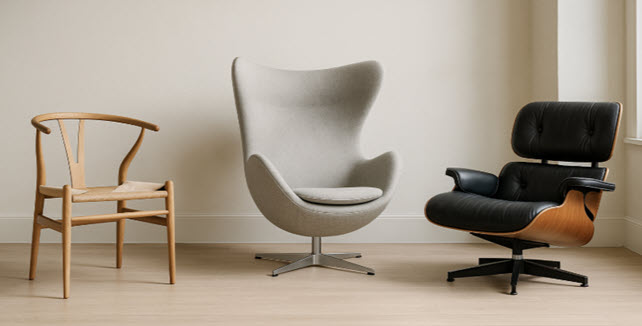
Some chairs become background. Others become legend.
Think of the Wishbone. The Egg. The Eames Lounge. These aren’t just places to sit. They’re symbols of eras, of philosophies, of a designer’s hand at work. But what exactly makes a chair iconic? Why do some chairs fade while others remain etched into design history, collected and copied for decades?
This is where design meets sculpture. Where form, function, and feeling converge into a shape that somehow just fits the body, the room, the time.
Here’s a closer look at what defines an iconic chair and how to recognize one when you see it.
Form That Resonates
Iconic chairs often share a strong visual silhouette. Something that holds even when you squint. The Wishbone Chair by Hans Wegner curves gently around the body with its Y-shaped back and paper cord seat. Arne Jacobsen’s Egg Chair wraps around the sitter like a cocoon. The Barcelona Chair by Mies van der Rohe is all sleek confidence and architectural tension.
In each case, the shape is memorable, immediate, and perfectly balanced.
Whether sculptural and bold or subtle and airy, the form of an iconic chair always feels intentional. You don’t just see it. You feel that someone thought through every angle.
Built for the Body
Great chairs respect ergonomics. Not in a clinical way, but through intuition. The seat depth. The angle of the back. The support at the curve of the spine.
The Eames Lounge Chair, for instance, was designed not just to recline, but to cradle. The Shell Chair sits low and wide, inviting a kind of casual sprawl. Even the sharply angular Zig-Zag Chair somehow conforms in just the right places.
When a chair feels this good, it disappears. The design holds you, but doesn’t get in your way.
Materials That Tell a Story
Material choice is another marker of greatness. Wishbone’s paper cord and oak. The Egg Chair’s wool upholstery over a fiberglass frame. The Cesca Chair’s mix of tubular steel and cane.
These materials don’t just serve structure. They express texture, weight, and tone. They connect the piece to its time, to the hand of the maker, and to the space around it.
Today, many iconic designs are reissued in new finishes, from matte black metal, pastel velvets, to smoked acrylic. But the originals endure because their materials still feel relevant, still invite touch.
How to Choose One for Your Space
Bringing an iconic chair into your home isn’t about chasing trends. It’s about choosing what resonates.
Ask yourself:
Do I want this chair to blend or stand out?
Will it be used often, or is it more sculptural?
Does the material suit my lifestyle? (kids, pets, direct sunlight?)
Can I see this piece still working in my home 10 years from now?
The best chairs don’t shout. They quietly upgrade the whole room.
Place one by the window and it becomes a reading spot. Place one near the entry and it becomes a pause point. Place one in a corner and it becomes art.
Iconic chairs are never just about looks. They carry the DNA of their era, the touch of their designer, and the quiet power to change how a room feels. To own one isn’t just to follow good design. It’s to live with a piece of history that still has something to say.